Showing posts with label Canyoneering Guides. Show all posts

Tuesday, January 25, 2011

American Canyoneering Association Guide Course, Arizona


American Canyoneering Association Founder and course instructor Rich Carlson


Pura Vida Adventures owner and head canyoneering guide, Joe Moerschbaecher just completed the American Canyoneering Association Guide Certification Course in Arizona last week. The American Canyoneering Association was started by Rich Carlson in 1999. The american canyoneering association does not just certify guides but in addition offers courses in basic rope skills, rigging, techniques, and rescue for recreational canyoneers. To learn more about the American Canyoneering Association (ACA) visit http://www.canyoneering.net/.


Over the years ACA has grown in popularity with both commercial canyoneering companies and recreational canyoneers. The ACA now holds recreational canyoneering courses and guide certification courses throughout the world including Mexico, Costa Rica, Scotland, Taiwan, and Nepal. The organization is truly world renowned within the canyoneering community.


The course in Arizona started with a three day recreational canyoneering course called the ART of Canyoneering. This provided those familiar with the techniques of rope skills and rigging an opportunity to assist participants who were not familiar with these skills. Joe commented that, "participating in the Art of Canyoneering workshop truly helped me to raise my ability level in rope technique and rigging by helping others less experienced in the skill set. In addition Rich Carlson the course instructor demonstrated and taught additional skills which I had yet to be exposed to which prepared me well for the upcoming ACA Guide course."

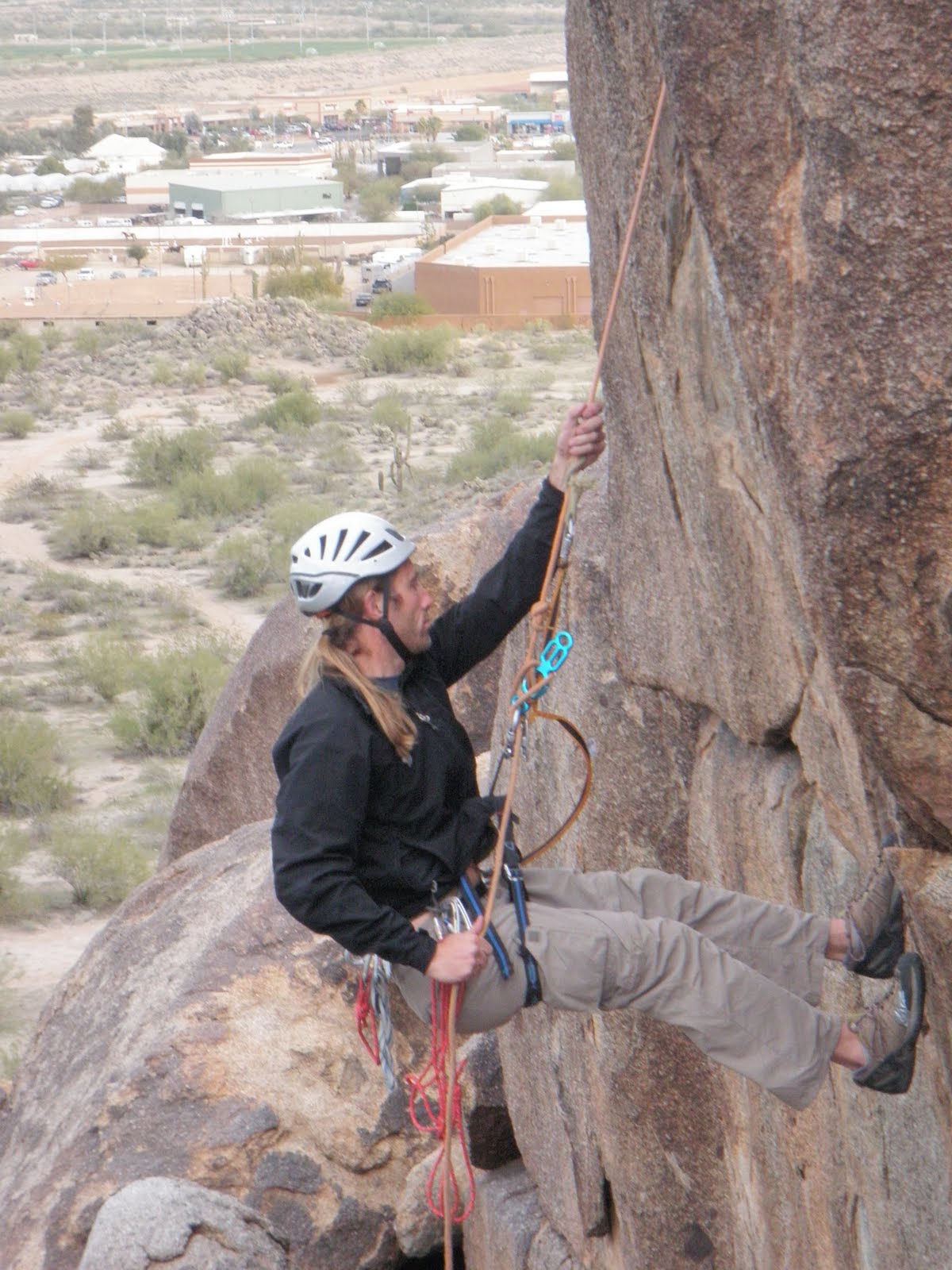
Guided Rappel


After the three day workshop the American Canyoneering Guide Course/Exam began. The course started with review and practice of many of the basic skills we had learned in the workshop. Later we went into more technical skills including, hauling and lowering a person stuck on a double stranded rope rappel, building deadman anchors, courtesy belays and sequencing of the the rappellers, and assitsing an injured person while being lowered.
Deadman anchor


The guide course and exam included daily evaluations for each participant by Rich Carlson the course instructor, as well as the other course participants. These daily evaluations allowed participants to get immediate daily feedback. The evaluations help to create the basis for the subjective portion of the course and exam. There were also two timed elements to the course which created a more objective evaluation method.


The timed elements of the exam were put in to place to add additional pressure to guide applicants to attempt to simulate the pressure placed on a guide when something goes wrong and a rescue skill needs to be used.
Rigging and Haul system practice

The first timed activity consisted of setting a rope length on a releasable system, rigging your client up for rappel and having them rappel half way down, the guide applicant being examined would then lower the client down a ways, the next step would be to convert to a 3:1 haul system and begin hauling the client back up. After hauling the client on a 3:1 haul system the guide would then convert to a 5:1 complex or 6:1 compound haul system to complete the exercise.


The second activity tested the guide's rope skills. Each guide was timed at riggging up and rappelling down, passing a knot on rappel, continuing to rappel and then converting to an ascend, while on rope before hitting the ground. The guide applicant would then ascend up the rope passing the knot while ascending and end the exercise when they made it back up to the top where they had began.
Passing a knot while on rappel


The guide exam included one final day where guide applicants took turns leading the group through El Cap Canyon. Along the way guide applicants where tested on various skills including pothole escape methods, rigging systems, guided rappels, courtesy belays on rappels, and lowering systems. Rich on this day also discussed various guiding procedures with us such as sequencing clients, providing clients with the proper information at the appropriate time, and identifying high risk areas and using various systems to minimize the risk in such areas.


Pothole escape
When the guide exam came to an end 60% of the guide applicants had passed the exam. The ACA requires more than just passing of the exam to receive the canyon guide certification. After passing the exam applicants must submit proof of a wilderness first responder, an outdoor resume, and a canyon resume. The application is the reviewed by the ACA board and once approved the guide certification is awarded.


Pura Vida Adventures, owner Joe Moerschbaecher had this to say about the course, "it has been a long time goal of mine to become a certified guide with the American Canyoneering Association. The guide exam is quite encompassing and very challenging, the opportunity to have been exposed to many of the skills on various other occassions through other ACA courses was invaluable and the many hours of practice put in preparing for the exam paid off. I am excited to have completed this first step in becoming a certified guide and hope to have my complete application completed and submitted in the next few months."


To find out more about Pura Vida Adventures canyoneering programs go to http://www.rappellingwaterfalls.com/ . More info about the American Canyoneering Association can be found at http://www.canyoneering.net/ .


Tuesday, December 28, 2010

Garganta del Diablo--- Canyoneering down the devil's throat Puerto Rico


After a week of instruction in canyoneering techniques and rescues in Puerto Rico's southern city of Ponce with American Canyoneering Association founder Rich Carlson, a group of 6 students and Rich went out to attempt the second descent of a canyon called El Barriel. The party included Alfonso and Jorge of Del Sur Adventures who had made the first descent of this canyon, as well as Miguel, Omar, and Ronnie students from the course. Pura Vida Adventures' canyoneering guide, Joe Moerschbaecher who had been down in Puerto Rico taking the course and Rich Carlson completed the 7 person party.

Expectations for the day were a 3 hour canyon descent that would include one 30ft, one 60ft and two 200ft rappels. We took two 200ft ropes and a 30 and 50 ft rope to set up a safety line before the first 200 ft rappel. The plan for the day was one of getting out to just do some canyoneering, minimmum instruction just getting out and playing after a long week of learning and drilling canyoneering techniques. What would come next was a real life exam in the skills we had learned and drilled for the past week.


Things went smoothly during the first rappel of 30 feet. We continued on to the 60ft rappel. The rigging used for this rappel was the Joker technique. The first three people made it down without incident. As Rich rigged to descend he noticed a core shot. He isolated the core shot. Once he got what he thought was confirmation the rope was long enough he began his descent. As he descended down he stopped and a give rope signal was given to us from the bottom. We gave Rich more rope on the Joker rigging system and all seemed to be well.

I rappelled next after confirming with Jorge the plan for breaking down the system with the new knot in the rope which isolated the core shot. Jorge assured me he had it all worked out and I was confident he did. When I descended down I saw the landing spot for the rappel. It was a ledge which was diamond shaped 2-3 ft long on the ends and 5-6ft long in the middle. The rappel rope had been knotted on the end, which eased my mind a bit, and as I sat in the falls still on the rappel I was a little puckered as I saw it would take a rappelling traverse to reach the ledge which was the only stationing area for the 200ft rappel to come next.


The ledge between the 60ft and first 200ft rappel

After digesting where I was and where I needed to go and pleased by the fact that the end of the rope was knotted. I committed to the bottom portion of the rappel and made it to the ledge. Ronnie offered assistance as I took myself off rappel. I now sat on the ledge but it was quite intimidating. I felt a life line would have truly been appropriate, but this was only the second descent and with no additional bolt placements available due to the conservation of the drill battery on the first descent there was no good way to place the lifeline.

As I got to the ledge Alfonso was rigging the next rappel which was 200ft. He was down first followed by Miguel. We were slowed a bit by the core shot but the problem had been solved and once again we had a good flow with everyone now on the ledge with the exception of Alfonso and Miguel who had already completed the next rappel. Ronnie rigged and began the 200ft rappel next, Rich observed as Ronnie began his rappel. Ronnie's eyes lit up Rich saw the core shot which had caused Ronnie's eyes to grow. Rich said to Ronnie why don't you ascend back up here. Ronnie calmly did. Rich's next words were "We are f_ _ _ ed" when canyoneering guru, Rich Carlson says this you tend to believe him.

After a short period of initial shock everyone began to evaluate options. Jorge left the 60 ft rappel up above in case we needed to use it to ascend back up because above the 60ft rappel it would be easy to exit the canyon left side. This was an option but would be a difficult ascent up a small waterfall which would cause the rope to rub the edge as water hit the body of the ascending person. Another option seemed available along the canyon left side of the ledge we were on, about 15 feet up it seemed it would be easy to scramble out of the canyon.

This I thought was the solution and as I mentioned it to Rich he was already in the process of bringing out his rescue bag and tying a large knot to see if we could catch anything when we went fishing, throwing the knot and rope above us to see if we could snag on something, anything. We began to work on this option as Jorge began to attempt to ascend the rope. If he could get above the 60 ft rappel he could then come around and set a rope on canyon left for the rest of us to ascend out both parties got to work and soon Jorge came back saying that the ascent may be possible but was risky and we should try fishing for a while. Jorge then turned his attention to Miguel and Alfonso managing the rope as they made their individual ascents up.

After about a dozen tries we seemed to have gotten a snag with the fishing line. Not sure how good a snag we had Rich and Ronnie assisted me up using a pyramid to minimize the weight we put on the snagged rope. As I left the pyramid and transferred a little more weight to the handline two thoughts went through my mind: the first thought was if I can get up another 5 ft. our problems should be solved, the second thought was if this handline gives I am going to take a bit of a tumble down. I had tested the line from the ground before beginning and was pretty confident it would hold. As I made it up the 15ft and let go of the lifeline on top I saw it had snagged between the rock face and a small dead shrub.
View from the top of the fixed rope which was our escape route out.

I grabbed the end of the rope and began moving up the side of the canyon another 8 feet where I found a suitable tree to use as an anchor. We were back in business Miguel had began his 200ft. ascent back up, Jorge was managing their ascending rope and soon after Omar and Ronnie had ascended up the side of the canyon which would be our escape route out. While others began the shorter ascent out of the canyon and Alfonso began the 200ft ascent I scouted ahead to find an exit route. Everyone made there way out of the canyon onto the bank and I pointed people to what I saw ahead and what I believed was the best way out.

Rich and Ronnie continued to explore up ahead and the other 5 of us grouped together and followed the trail they had made as they pushed their way through the vines and grass.

The bushwack out

Soon after that we were back at the car and after a short drive at a bar telling the story from each individual perspective. At the bar Alfonso and Jorge told the story of their first descent and Rich asked the name of the canyon El Barriel was what they replied saying it was the name of the major tributary of which the canyon flowed in. I commented to Jorge and Alfonso that I would have called it Garganta del Dieblo (throat of the Devil). Jorge laughed and said he liked that name, so whether it is called El Barriel or Garganta del Dieblo is up Jorge and Alfonso, but I believe this particular trip would best be described as travelling through Garganta del Dieblo.
View of the canyon from above

Sometimes canyoneering courses seem to cover all the worst case scenarios and you say to yourself when will I need to use these skills. Sure it is true if everything always goes right you will not need to use many of these worse case scenarios skills, but when things go wrong you may need use many of these tools. Some of the tools we needed to use on this trip, which would not have been used if all went well included: isolating a core shot, lowering on a releasable system, passing a knot on ascend and rappel, locking off your rappel device, "fishing" pot hole escape, pyramid pot hole escape, land navigation, and bushwacking.
Video of the first descent of Garganta del Diablo
Pura Vida Adventures offers canyoneering instruction and guided canyoneering trips. Find out more at http://www.rappellingwaterfalls.com/

Thursday, December 23, 2010

American Canyoneering Course in Puerto Rico


Pura Vida Adventures' canyoneering guide Joe Moerschbaecher recently returned from an American Canyoneering Association Canyon Leader Course in Puerto Rico.

The course included 4 days of canyoneering instruction including techniques, rescue and rigging.


Days 5 and 6 of the course included continuing instruction and the canyon leader exam.
During the exam participants were timed in their ability to ascend a rope pass a knot and continue ascending the rope then descend the rope pass a knot and continue descending the rope. The second timed portion of the exam consisted of rigging a releasable system rappelling a client part way down then converting to a lowering system. After converting to a lower participants then had to convert to a 3:1 haul system followed by their choice of a complex 5:1 or compound 6:1 haul system. This first portion of the exam was the objective portion looking at times for completeing the taskS and mistakes made along the way.


The second day of the exam was more subjective and looked at how participants operated and applied the systems learned in a canyon. During this portion of the exam participants rigged releasable rappels, guided rappels, ascended and rappelled ropes, practiced pot hole escapes, and various other techniques.


The course was taught by American Canyoneering Association founder, Rich Carlson.
During the course Rich emphasized minimizing the gear needed in a canyon by carrying the most multifunctional pieces of equipment possible. Some of the new pieces of equipment Rich introduced to participants included the Purcell Prussik and VT Prussik.
Pura Vida Adventures owner, Joe Moerschbaecher was very pleased with the training stating, "Rich Carlson and the American Canyoneering Association does a top notch job in canyoneering instruction covering all the issues canyoneering participants and guides may encounter in a canyon." Pura Vida Adventures will be sure to take many of the principles and techniques learned in the course and apply them in both our guided canyoneering trips and instructional courses.
Joe's training with the American Canyoneering Association (ACA) will not end here in Jan. he is headed to Phoenix Arizona to continue working on his canyon guide certification through the ACA.

Tuesday, August 10, 2010

Cascading and Canyoneering Programs in North Carolina Highlighted in Aug. 2010 Blue Ridge Outdoors Magazine


Pura Vida Adventures is proud to be featured in the August 2010 Issue of Blue Ridge Outdoors Magazine. The article entitled Cascading talks about the budding sport of southeastern canyoneering.


Graham Averil, the article's writer talks aboutthe development of the sport and recommends some beginner cnyoneering options in both North Carolina and Virginia. In addition it speaks of Pura Vida Adventures Canyoneering programs for those interested in a more technical canyoneering and cascading adventure.

Graham goes on to call Pura Vida Adventures owner Joe Moerschbaecher a "cascading pioneer". To read the full article visit the following link:

http://www.blueridgeoutdoors.com/current-issue/features/cascading/

Two new canyoneering programs are almost completely developed by Pura Vida Adventures and details will be coming soon, also twwo day canyoneering instructional programs are currently being scheduled for Aug. and Sept. please contact us for more details.